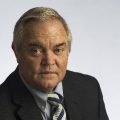
Billy Packer will be remembered for those loud and plaid sportscoats, the headsets over his ears, and his sometime stinging commentary. And as an iconic television college basketball analyst for more than three decades.
He knew the coaches from Dean Smith, Mike Krzyzewski, Jim Valvano, Roy Williams, Terry Holland, Bobby Cremins and Norm Sloan to Lefty Driesell. He knew the athletes from Michael Jordan, David Thompson, Eric Montross, Phil Ford, Tyler Hansbrough, Christian Laettner, Bobby Hurley, Grant Hill and Len Elmore to the late Lozrenzo Charles and the late Len Bias.
Billy Packer knew the game.
“Skeeter Francis called me one day and he said, ‘How would you like to see N.C. State play Maryland?’” he once told in a story about Marvin Conference and Packer’s introduction to broadcasting. “So, I said sure, and I picked him up in Greensboro and we drive over to Raleigh and Skeeter said, ‘Now, Billy, I’m going to tell you something right now. I was supposed to get a fill-in announcer, and I forgot all about it until yesterday. So, you’re the only guy I know to try this without any practice.’
“I knew the teams, I knew the coaches, I knew the history. But I didn’t know how to put on the headset, and so a guy named Jim Thacker, who was a great broadcaster for the Atlantic Coast Conference, turned out to be the man that was doing the play-by-play, and he knew who I was.
“So, I sat down and said what I saw, and at halftime they gave me a free Coke and I’m saying, ‘Man, this is really a neat thing to do,’” said Packer, who was a starting guard on the 1961-62 Wake Forest University team that would reach the NCAA Final Four. “The game was over, and Skeeter went a different way, so I drove home by myself and I started thinking, ‘You know, I’d like to do that again.’”
And Billy Packer did for 36 seasons, from the ACC’s famed Tobacco Road to his coverage for NBC (1974-81) and CBS (1981-2008) of every March Madness Final Four until his forced retirement in 2008, when CBS replaced Packer with Clark Kellogg. Broadcast mates included Thacker, Curt Gowdy, Dick Enberg, Al McGuire, Gary Bender, Brent Musburger, Tim Brandt, Vern Lundquist and Jim Nantz.
From Tobacco Road to Putt-Putt
College basketball analyst was his signature.
But some of us came to know Billy Packer as the play-by-play announcer for the PPA championships of Putt-Putt Golf Courses, which was founded in this city on June 21, 1954, by the late Don Clayton.
“Billy Packer was introduced to Putt-Putt and the PPA by longtime Putt-Putt owner Wilbur Hildebrand,” says Joe Aboid, 67, a former city resident and now commissioner of the Professional Putters Association founded by Clayton in 1960. “Because of that friendship, Billy Packer agreed to become a commentator on the PPA TV series. And even though the PPA syndicated TV series had been produced for more than 15 years prior to Packer joining, it wasn’t until he became the primary commentator that notoriety of our sport was established.”
Packer came to know the players with putters, just as he knew the college basketball athletes.
“Packer was so professional,” Aboid says. “He learned about the players, their professions, their likes and dislikes, their families and personalities. He would be able to talk about them casually on the broadcast often without notes. He said many times that when he traveled to cities that had Putt-Putt locations, he was recognized as much for his PPA commentary as his commentary on college basketball. He was a true gentleman and friend to all PPA players and Putt-Putt owners.”
Although I came to know Billy Packer from my years as a sports editor for our local newspapers, I was one of those players with the PPA tour. And it was Billy Packer who would call my matches in the 1986 television series in Gastonia.
“When he’s not working as a sports editor, you’ll find him at the PPA tournaments,” he would say. “He started at age 11, and he’s a veteran player. And look at the raggedy grip on that Bullseye putter.”
He would call two of my five career televised matches, including the 1992 PPA Skins at the old Putt-Putt Golf Course on Owen Drive.
Your support for CityView helps ensure a more informed community. Donate today.
‘Billy Packer was the Final Four’
Dean Dwiggins was a putting competitor, too, and grew up in Winston-Salem not far from Billy Packer’s two-story home that then was along the second and third holes of Bermuda Run Country Club outside Clemmons.
Like so many, he came to know Packer first as a college basketball analyst.
“Billy Packer was quite an interesting guy, not your typical sports announcer,” says Dwiggins, 60, who now resides in Pinehurst. “Billy was involved to announce the game, provide insightful analysis on the game and strategies, and he did not like to show favoritism or be funny.
“The Final Four is not the same without Billy Packer. Billy Packer was the Final Four.
“Billy was on the only Wake Forest basketball team to make the Final Four,” Dwiggins says about the 1961-62 season when the Deacons under Coach Bones McKinney finished with a 22-9 record that included winning the ACC conference and tournament titles. “Wake Forest defeated UCLA in the Final Four consolation game in 1962. The next time that UCLA lost in the NCAA basketball tourney was to N.C. State in Greensboro in 1974. Billy was an assistant coach to Jack McCloskey at Wake Forest for some years in the mid-60s and was instrumental in the recruitment of Charlie Davis to Winston-Salem, one of the Demon Deacons’ all-time greats and the 1971 ACC player of the year.”
Dwiggins would come to know Packer’s son, Mark, now an announcer for the ACC Network and ESPN, when both worked at the Putt-Putt Golf Course as youngsters in Winston-Salem. Dwiggins later would appear four times on the PPA Skins series, with Packer calling the putts.
“Billy was a talented announcer, and even better when the camera lights came on,” Dwiggins says. “He came upon the Putt-Putt and PPA television series because of his friendship with Wilbur Hildebrand, the longtime owner of Putt-Putt courses in Winston-Salem, Charlotte, Norfolk and Virginia Beach, Virginia. Billy invested in getting to know the PPA players, their knowledge of the course and preferred shots, straight or a bank shot, and their interests outside of the PPA.”
Dwiggins remembers competing in the 1985 PPA Skins Game.
“My father owned the Wake Forest Barber Shop for 30 years and cut Billy’s hair while an undergraduate at Wake Forest,” he says. “At my first PPA television series appearance in 1985, Billy notices that I am from Winston-Salem and asks me if my father was a barber at Wake Forest. We enjoyed a nice laugh over that and always talked about it.”
‘Like no other analyst’
Billy Packer died Jan. 26 in Charlotte.
He was 82.
Billy Packer never attended a college basketball game after Kansas defeated Memphis, 75-68, in overtime of the NCAA finals at the Alamodome in San Antonio, Texas.
“As a 12-year-old Baltimore kid/Terps fan mesmerized by Tom McMillen’s jump shot, Len Elmore’s power and Lefty Driesell’s showmanship, I was watching,” writes David Teel, a former sportswriter for The Fayetteville Times and now with The Richmond Times-Dispatch. “And like countless others, I continued watching Packer until his last telecast at the 2008 Final Four. Packer taught you about the game and its characters — mercy, there were some characters — like no other analyst.”
When it came to the broadcast booth or along the arena’s front row, Billy Packer was one of a kind who told it like it was, and without apology. He earned a Sports Emmy in 1993 and, in 1996, the Curt Gowdy Media Award presented by the Naismith Memorial Basketball Hall of Fame.
“He was just fantastic,” says Joe Quigg, the retired Fayetteville dentist who scored the winning free throws in a third overtime to lead the University of North Carolina to a 54-53 win over Kansas in the 1957 NCAA national championship.
Epilogue
Billy Packer was so much more than we came to know on television.
He recruited Charlie Davis to Wake Forest University as the ACC’s first Black player and remained a loyal friend to Davis until Packer’s final days. He championed Black basketball players including Cleo Hill and Earl Monroe at Winston-Salem State University. Packer had no tolerance for racism. He was proud of his children to include Brandt Packer, now with the Golf Channel as a producer. And Billy Packer was a devoted and caring husband to his wife during her later years of declining health.
For those who came to admire Billy Packer as a college basketball analyst, Billy Packer was a part of you whether in the Dean E. Smith Center, Reynolds Coliseum, Cameron Indoor Stadium or Lawrence Joel Veterans Memorial Coliseum in Winston-Salem.
And for those of us who played a game of another kind with the obstacles, the run-a-rounds, the loops, the intimidating reverse drop-offs, the orange-colored bump boards and the fabricated mountains along our way, Billy Packer always will be a part of us, too.
Bill Kirby Jr. can be reached at billkirby49@gmail.com or 910-624-1961.